
Skip to content
neiglobe

Technology

Bringing the cloud to where the network isn't.

Vicino AI implements the Locally Accessible Cloud System (LACS) architecture: rather than restoring a link to distant servers, it brings the service functions physically into the affected area.

Where the infrastructure breaks

People reach the internet through an access network of base stations and fibre, connected onward through communication buildings and a transport network to distant data centres. In a disaster, the access network fails first — base stations lose power, fibre is cut. In a large-scale event, communication buildings and transport networks are damaged too. Everything downstream stops.

  1. 01

    Access network

    Base stations, fibre

    Fails first

  2. 02

    Transport network

    Communication buildings

    At risk in large events

  3. 03

    Internet / data centres

    Distant services

    Intact but unreachable

Access networkTransport networkInternetMobile usersHousehold usersOptical fibresCommunication buildingsData centresSocial networking servicee-Commerce serviceInformation search serviceDamaged in a disaster — telephone and Internet both go down
Figure 1. Possible damage to ICT infrastructure under disasters

The LACS architecture

LACS is a portable system that temporarily forms an internet-like environment in its surrounding area, delivering ICT services locally. People near the unit use their own smartphones to collect and share information and to reach family and colleagues. The core idea is to move the service functions to the local area and integrate them with whatever access network survives or is newly deployed.

  • Information delivery
  • Information sharing (SNS)
  • Bi-directional communication (messaging)
  • …and other everyday services

…delivered by one local unit, with no internet behind it

Figure 2. Locally Accessible Cloud System concept

Research origin

The LACS concept was proposed in 2019 by Dr. Toshikazu Sakano, a director at the Advanced Telecommunications Research Institute International (ATR) in Kyoto. A prototype was developed and a series of feasibility studies conducted with support from Japanese Government R&D funding. Neiglobe holds a licence from ATR for LACS and develops Vicino AI as its commercial edition.
ITU-T L.392

Approved in April 2016, ITU-T Recommendation L.392 addresses disaster management for improving network resilience and recovery using Movable and Deployable ICT Resource Units (MDRUs) — collections of ICT resources packaged as portable units that can be rapidly deployed to substitute damaged network facilities. Vicino AI conforms to this recommendation and can be classed as a Network-in-a-Box solution.

Read the recommendation
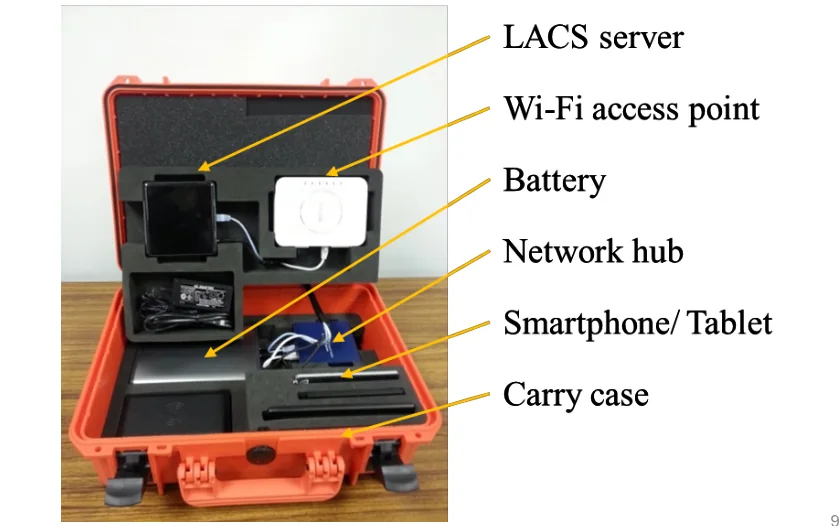
The LACS pilot unit — a case holding a small server, Wi-Fi access point and battery.
Figure 3. The LACS pilot unit
ItemSpecification
Communication
Connected devicesSmartphone / Tablet / PC
Access systemWi-Fi 802.11a/b/n/g/ac, Ethernet
Maximum concurrent connections5 GHz: 128 · 2.4 GHz: 128
Server
CPUIntel Core i7
Main memory16 GB
Storage512 GB SSD
Operating systemLinux
Electric power
Battery capacity50,000 mAh
Power dissipation25 W/h
Maximum operating timeAbout 8 hours
Dimensions
External dimensions336 × 300 × 148 mm
Weight4.5 kg
Software
Web serverApache2
Info. deliveryInformation broadcasting
Info. sharingContents upload and browsing by users
CommunicationChat among users
Table 2. Typical specifications
UserDisaster situationNon-disaster situation
National / local government, fire station, police, hospitals
  • Usage in disaster response headquarters
  • Usage in other organizations that support the activities in disasters, like hospitals
  • Drills for disaster prevention
  • Daily use in the government work
People in disaster areas / residential areas
  • Offer a tool for information delivery and sharing in a disaster-affected area with no Internet.
  • To offload the condensed traffic at events.
  • Daily use in residential areas as a conventional information sharing tool.
People in developing areasUse as an instant ICT installation tool in developing areas with not-rich network infrastructure.
Table 1. Expected use cases

References

  1. [1]T. Sakano et al., "Disaster-Resilient Networking: A New Vision Based on Movable and Deployable Resource Units," IEEE Network, vol. 27, no. 4, pp. 40–46, Aug. 2013. DOI ↗
  2. [2]T. Sakano et al., "Bringing Movable and Deployable Networks to Disaster Areas: Development and Field Test of MDRU," IEEE Network, vol. 30, no. 1, pp. 86–91, Jan. 2016. DOI ↗
  3. [3]Recommendation ITU-T L.392, "Disaster management for improving network resilience and recovery with movable and deployable ICT resource units," April 2016. ITU-T ↗
  4. [4]R. Teng, T. Sakano and Y. Suzuki, "Instantaneous Networking Service Availability for Disaster Recovery," Appl. Sci. 2020, 10(24), 9030. DOI ↗
  5. [5]T. Sakano, B. Ojetunde, Y. Suzuki, J. N. Llanto and C. Sharma, "Feasibility study of Locally Accessible Cloud System (LACS) conducted in a remote island in Cebu, Philippines," 2nd International Symposium on Disaster Resilience & Sustainable Development, June 2021.
  6. [6]B. Ojetunde, S. Ano and T. Sakano, "A Practical Approach to Deploying a Drone-Based Message Ferry in a Disaster Situation," Appl. Sci. 2022, 12(13), 6547. DOI ↗

See it work where nothing else does.

We run live field demonstrations tailored to your environment — your terrain, your failure modes, your team.